
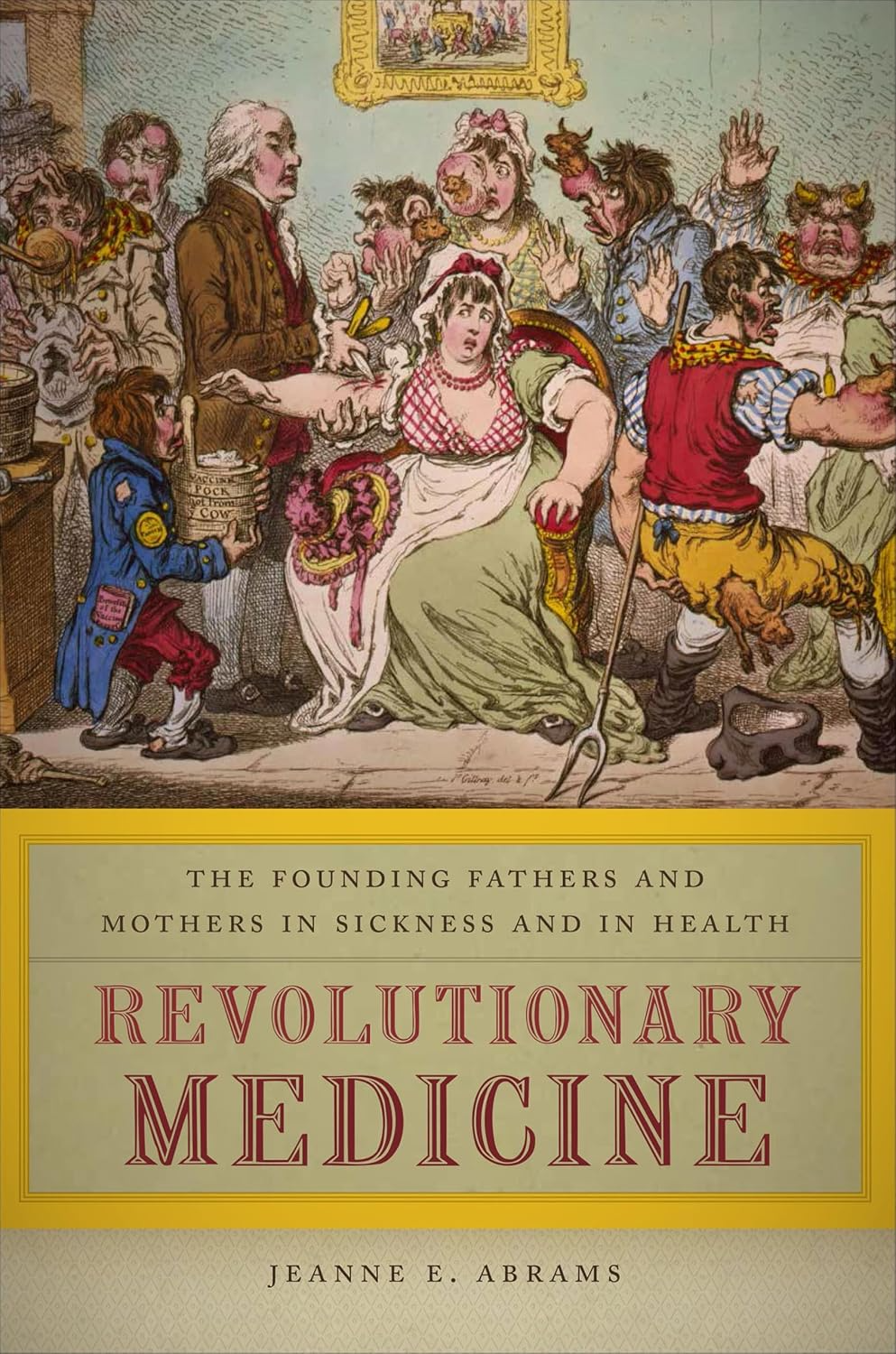
Before the advent of modern antibiotics, one’s life could be abruptly shattered by contagion and death, and debility from infectious diseases and epidemics was commonplace for early Americans, regardless of social status. Concerns over health affected the founding fathers and their families as it did enslaved people, merchants, immigrants, and indeed everyone in North America. As both victims of illness and national leaders, the Founders occupied a unique position regarding the development of public health in America. Revolutionary Medicine refocuses the study of the lives of George and Martha Washington, Benjamin Franklin, Thomas Jefferson, John and Abigail Adams, and James and Dolley Madison away from the usual lens of politics to the unique perspective of sickness, health, and medicine in their era.
For the founders, republican ideals fostered a reciprocal connection between individual health and the “health” of the nation. Studying the encounters of these American founders with illness and disease, as well as their viewpoints about good health, not only provides us with a richer and more nuanced insight into their lives, but also opens a window into the practice of medicine in the eighteenth century, which is at once intimate, personal, and first-hand. Perhaps most importantly, today’s American public health initiatives had their roots in the work of America’s founders, for they recognized early on that government had compelling reasons to shoulder some new responsibilities with respect to ensuring the health and well-being of its citizenry. The state of medicine and public healthcare today is still a work in progress, but these founders played a significant role in beginning the conversation that shaped the contours of its development.
Jeanne Abrams received her Ph.D. in American History with a specialization in Archival Management from the University of Colorado at Boulder and was a member of the faculty of the University of Denver since 1983 in the Center for Judaic Studies and University Libraries. In 2006, she was promoted to full Professor, and she is currently a DU Professor Emerita. She has also served as the longtime curator of the Beck Archives of Rocky Mountain Jewish History, part of Special Collections at the University of Denver Libraries, and she is well known locally as well as nationally for her expertise in medical, early American, and American Jewish history.
Register here to attend this webinar on 1/13 at 2pm EST